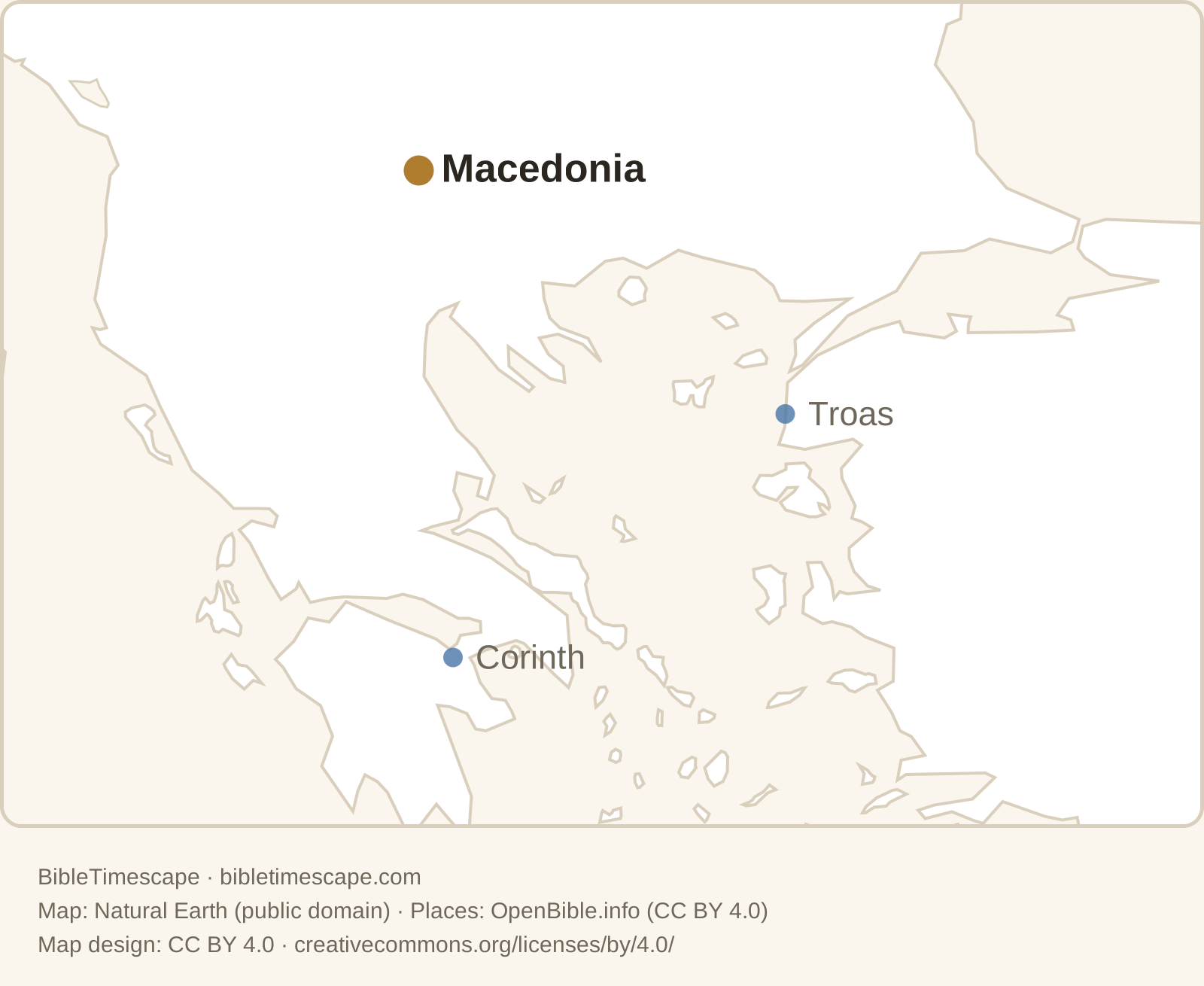
Paul and Timothy addressed the church at Corinth and the believers throughout Achaia after Paul left Troas for Macedonia (2 Corinthians 1:1-11; 2:12-17). Titus met Paul there with news of the Corinthians' longing and repentance, and Paul urged them to complete their collection for the saints and prepare for his coming (2 Corinthians 7:5-9:15; 12:14-13:14). Acts records that Paul traveled from Ephesus through Macedonia before continuing to Greece (Acts 20:1-3).
Written in Macedonia after Titus returned with news from Corinth and before Paul continued to Greece; Scripture gives no calendar year for the letter
📖 2 Corinthians 1:1–3
1Paul, an apostle of Christ Jesus by the will of God, and Timothy our brother, To the church of God in Corinth, together with all the saints throughout Achaia: 2Grace and peace to you from God our Father and the Lord Jesus Christ. 3Blessed be the God and Father of our Lord Jesus Christ, the Father of compassion and the God of all comfort,
Connections
Quotation
A Father with sons and daughters
Paul joins God's words about a father and son with Isaiah's words about sons and daughters. He uses them to describe God's family.
2 Samuel 7:14
I will be his Father, and he will be My son. When he does wrong, I will discipline him with the rod of men and with the blows of the sons of men.
Isaiah 43:5–6
Do not be afraid, for I am with you; I will bring your offspring from the east and gather you from the west. I will say to the north, ‘Give them up!’ and to the south, ‘Do not hold them back!’ Bring My sons from afar, and My daughters from the ends of the earth—
Second Samuel 7:14 says, "I will be his Father, and he will be My son." Isaiah 43:6 speaks of God's sons and daughters. Second Corinthians 6:18 brings both parts together in God's promise to be a Father to His sons and daughters.
Quotation
Two or three witnesses
Paul quotes the rule that a matter must be established by two or three witnesses.
Deuteronomy 19:15
A lone witness is not sufficient to establish any wrongdoing or sin against a man, regardless of what offense he may have committed. A matter must be established by the testimony of two or three witnesses.
Deuteronomy 19:15 says that one witness is not enough and that a matter must be established by two or three witnesses. Second Corinthians 13:1 repeats that rule as Paul prepares to return to Corinth.
Quotation
Neither excess nor shortage
Paul quotes the manna account. The one who gathered much had no excess, and the one who gathered little had no shortage.
Exodus 16:17–18
So the Israelites did this. Some gathered more, and some less. When they measured it by the omer, he who gathered much had no excess, and he who gathered little had no shortfall. Each one gathered as much as he needed to eat.
Exodus 16:17-18 says that some Israelites gathered more manna and some less, yet each had what was needed. Second Corinthians 8:15 introduces the same words with, "As it is written."
Pattern
Moses' shining face and veil
Paul points back to Moses' shining face and veil. He contrasts that account with believers who behold the Lord's glory with unveiled faces.
Exodus 34:29–31
And when Moses came down from Mount Sinai with the two tablets of the Testimony in his hands, he was unaware that his face had become radiant from speaking with the LORD. Aaron and all the Israelites looked at Moses, and behold, his face was radiant. And they were afraid to approach him. But Moses called out to them; so Aaron and all the leaders of the congregation returned to him, and Moses spoke to them.
Exodus 34 says that Moses' face shone after he spoke with the LORD and that he covered it with a veil. Second Corinthians 3 names Moses, the stone tablets, the glory on his face, and the veil as Paul develops his comparison.
Pattern
Light shines out of darkness
Paul reaches back to God's command for light to shine out of darkness. He compares creation's light with God shining in human hearts.
Genesis 1:1–3
In the beginning God created the heavens and the earth. Now the earth was formless and void, and darkness was over the surface of the deep. And the Spirit of God was hovering over the surface of the waters. And God said, “Let there be light,” and there was light.
Genesis 1 records darkness over the earth and God's command, "Let there be light." Second Corinthians 4:6 identifies God as the One who told light to shine out of darkness, then says that He made His light shine in human hearts.
Pattern
As Eve was deceived
Paul compares false teaching in Corinth to the serpent's deception of Eve. He warns that their minds could be led away from devotion to Christ.
Genesis 3:1–3
Now the serpent was more crafty than any beast of the field that the LORD God had made. And he said to the woman, “Did God really say, ‘You must not eat from any tree in the garden?’” The woman answered the serpent, “We may eat the fruit of the trees of the garden, but about the fruit of the tree in the middle of the garden, God has said, ‘You must not eat of it or touch it, or you will die.’”
Genesis 3 records the serpent's words and Eve's statement that the serpent deceived her. Second Corinthians 11:3 names that deception and applies it as a warning to the Corinthian believers.
Quotation
Now is the day of salvation
Paul quotes God's promise to answer in the time of favor and help in the day of salvation. He then says that now is that time.
Isaiah 49:8
This is what the LORD says: “In the time of favor I will answer You, and in the day of salvation I will help You; I will keep You and appoint You to be a covenant for the people, to restore the land, to apportion its desolate inheritances,
Isaiah 49:8 promises an answer in the time of favor and help in the day of salvation. Second Corinthians 6:2 quotes that promise before saying, "Now is the day of salvation!"
Quotation
Come out and touch no unclean thing
Paul uses Isaiah's call to leave what is unclean. He applies it to his warning against idolatry in Corinth.
Isaiah 52:11
Depart, depart, go out from there! Touch no unclean thing; come out from it, purify yourselves, you who carry the vessels of the LORD.
Isaiah 52:11 tells God's people to depart, come out, and touch no unclean thing. Second Corinthians 6:17 repeats these commands after Paul contrasts God's temple with idols.
Pattern
The sinless One bears sin for others
Paul says the sinless Christ bore sin for others so they could become righteous in Him. Isaiah describes a righteous Servant who bears sin and makes many righteous.
Isaiah 53:6
We all like sheep have gone astray, each one has turned to his own way; and the LORD has laid upon Him the iniquity of us all.
Isaiah 53:9–11
He was assigned a grave with the wicked, and with a rich man in His death, although He had done no violence, nor was any deceit in His mouth. Yet it was the LORD’s will to crush Him and to cause Him to suffer; and when His soul is made a guilt offering, He will see His offspring, He will prolong His days, and the good pleasure of the LORD will prosper in His hand. After the anguish of His soul, He will see the light of life and be satisfied. By His knowledge My righteous Servant will justify many, and He will bear their iniquities.
Isaiah says that the Servant had done no violence, that the LORD laid the people's iniquity on Him, and that the righteous Servant would bear their sins and justify many. Second Corinthians 5:21 says that Christ knew no sin but was made sin for us so that we might become God's righteousness in Him.
Quotation
Seed for the sower and bread for food
Paul uses Isaiah's words about God providing seed to sow and food to eat. He applies the picture to God supplying and multiplying what believers can give.
Isaiah 55:10
For just as rain and snow fall from heaven and do not return without watering the earth, making it bud and sprout, and providing seed to sow and food to eat,
Isaiah 55:10 describes rain giving seed to the sower and bread to the eater. Second Corinthians 9:10 uses the same words for God, who supplies and multiplies seed and increases the harvest of righteousness.
Covenant thread
Written on hearts made new
The prophets spoke of God writing on hearts and replacing hearts of stone. Paul uses this language as he describes the Corinthians and his ministry of the new covenant.
Jeremiah 31:33
“But this is the covenant I will make with the house of Israel after those days, declares the LORD. I will put My law in their minds and inscribe it on their hearts. And I will be their God, and they will be My people.
Ezekiel 11:19
And I will give them singleness of heart and put a new spirit within them; I will remove their heart of stone and give them a heart of flesh,
Ezekiel 36:26
I will give you a new heart and put a new spirit within you; I will remove your heart of stone and give you a heart of flesh.
Jeremiah 31:33 says that God will write His law on His people's hearts. Ezekiel 11:19 and 36:26 promise a new heart and a heart of flesh in place of stone. In 2 Corinthians 3:3-6, Paul says that the Spirit writes on human hearts and that God made him a minister of a new covenant.
Quotation
Let the one who boasts boast in the Lord
Paul repeats Jeremiah's call to boast in the Lord instead of praising oneself.
Jeremiah 9:23–24
This is what the LORD says: “Let not the wise man boast in his wisdom, nor the strong man in his strength, nor the wealthy man in his riches. But let him who boasts boast in this, that he understands and knows Me, that I am the LORD, who exercises loving devotion, justice and righteousness on the earth— for I delight in these things,” declares the LORD.
Jeremiah 9:23-24 tells the wise, strong, and wealthy not to boast in themselves, but to boast in knowing the LORD. Second Corinthians 10:17 repeats, "Let him who boasts boast in the Lord," then says that the Lord's approval matters.
Quotation
God will dwell among His people
Paul uses God's promise to dwell and walk among His people. He applies those words to believers as the temple of the living God.
Leviticus 26:11–12
And I will make My dwelling place among you, and My soul will not despise you. I will walk among you and be your God, and you will be My people.
Leviticus 26:11-12 says that God will dwell and walk among His people and be their God. Second Corinthians 6:16 repeats these promises after saying, "We are the temple of the living God."
Quotation
Gifts scattered to the poor
Paul quotes Psalm 112 about giving freely to the poor and righteousness that endures.
Psalms 112:9
He has scattered abroad his gifts to the poor; his righteousness endures forever; his horn will be lifted high in honor.
Psalm 112:9 says that the God-fearing person scatters gifts to the poor and that his righteousness endures forever. Second Corinthians 9:9 repeats these words as written Scripture while Paul encourages generous giving.
Quotation
I believed, therefore I spoke
Paul quotes Psalm 116:10. The psalmist believed and spoke, and Paul says that he also believes and speaks.
Psalms 116:10
I believed, therefore I said, “I am greatly afflicted.”
Psalm 116:10 says, "I believed, therefore I said." Second Corinthians 4:13 introduces the same words as written Scripture and says, "I believed, therefore I have spoken."